
Electronic excitations in light-converting systems
“Since the scientific revolution, “divide and conquer” has been a route to understanding, but much depends on the divisions that are made.”
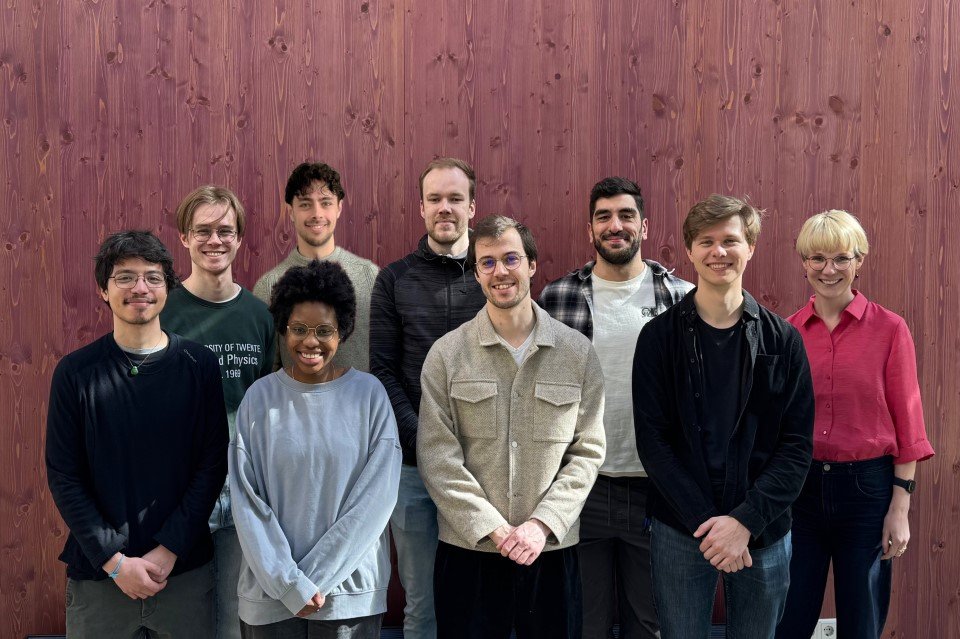
Group photo March 2026
We are part of
School of Metallurgy and Materials, University of Birmingham, UK
Computational Chemical Physics at the MESA+ Institute of Nanotechnology, University of Twente, The Netherlands


Methods
We use and develop (time-dependent) density functional and many-body perturbation theory to understand and predict the electronic structure and dynamics of complex systems.
Materials
We are interested in inorganic, organic-inorganic and biological materials and systems. A particular focus of the last years have been the halide perovskites.
Phenomenology
What drives us is a desire to understand the elementary excitations that are responsible for energy and charge transfer in light-converting systems - from solar cells to photosynthesis.